Choose Any CompTIA XK0-006 Exam Dumps Format and Start Preparation
Wiki Article
2026 Latest DumpsValid XK0-006 copyright and XK0-006 copyright Free Share: https://drive.google.com/open?id=1Z2xXbm1pbClSbbs-MrRTKDziC0bMqK21
Computers are changing our life day by day. We can do many things on computers. Technology changes the world. If you have dream to be a different people, obtaining a CompTIA certification will be the first step. XK0-006 learning materials will be useful for you. As you can see the Forbes World's Billionaires List shows people starting bare-handed are mostly engaging in IT field. XK0-006 Learning Materials may be the first step to help you a different road to success.
CompTIA XK0-006 Exam copyright Topics:
| Topic | Details |
|---|---|
| Topic 1 |
|
| Topic 2 |
|
| Topic 3 |
|
| Topic 4 |
|
100% Pass 2026 XK0-006: CompTIA Linux+ Certification Exam –Efficient Books PDF
Our XK0-006 exam guide is suitable for everyone whether you are a business man or a student, because you just need 20-30 hours to practice it that you can attend to your exam. There is no doubt that you can get a great grade. If you follow our learning pace, you will get unexpected surprises. Only when you choose our XK0-006 Guide Torrent will you find it easier to pass this significant XK0-006 examination and have a sense of brand new experience of preparing the XK0-006 exam.
CompTIA Linux+ Certification Exam Sample Questions (Q109-Q114):
NEW QUESTION # 109
A junior system administrator removed an LVM volume by mistake.
INSTRUCTIONS
Part 1
Review the output and select the appropriate command to begin the recovery process.
Part 2
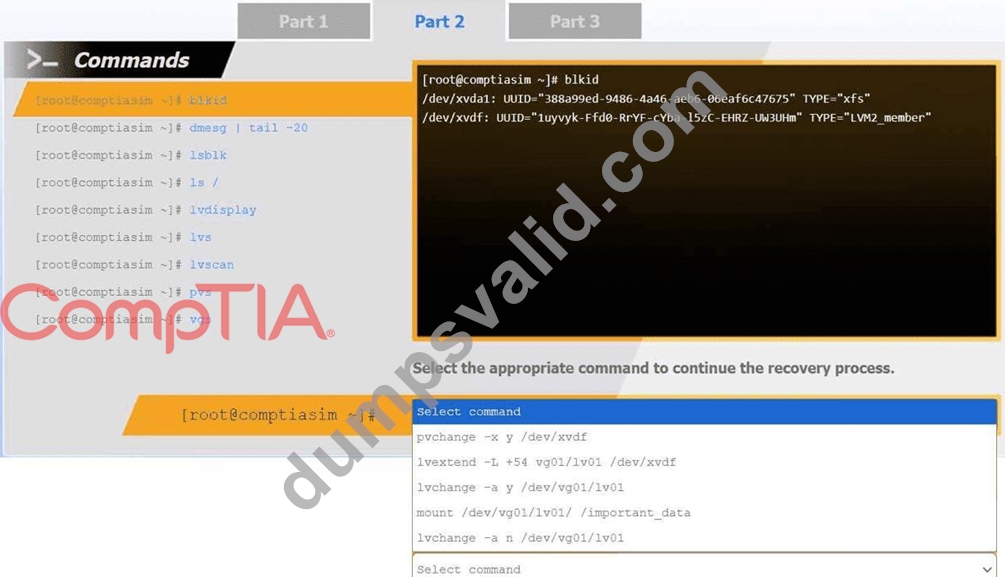
Review the output and select the appropriate command to continue the recovery process.
Part 3
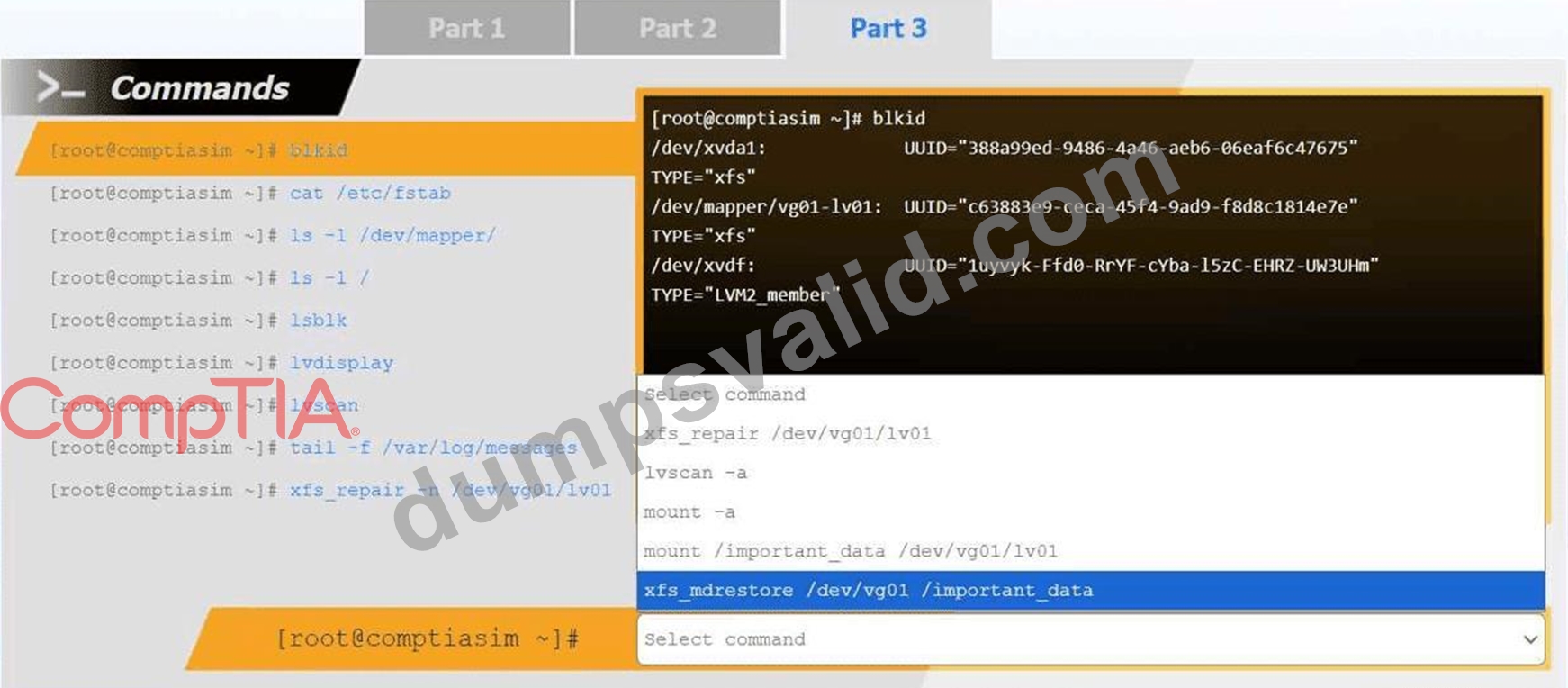
Review the output and select the appropriate command to complete the recovery process and access the underlying data.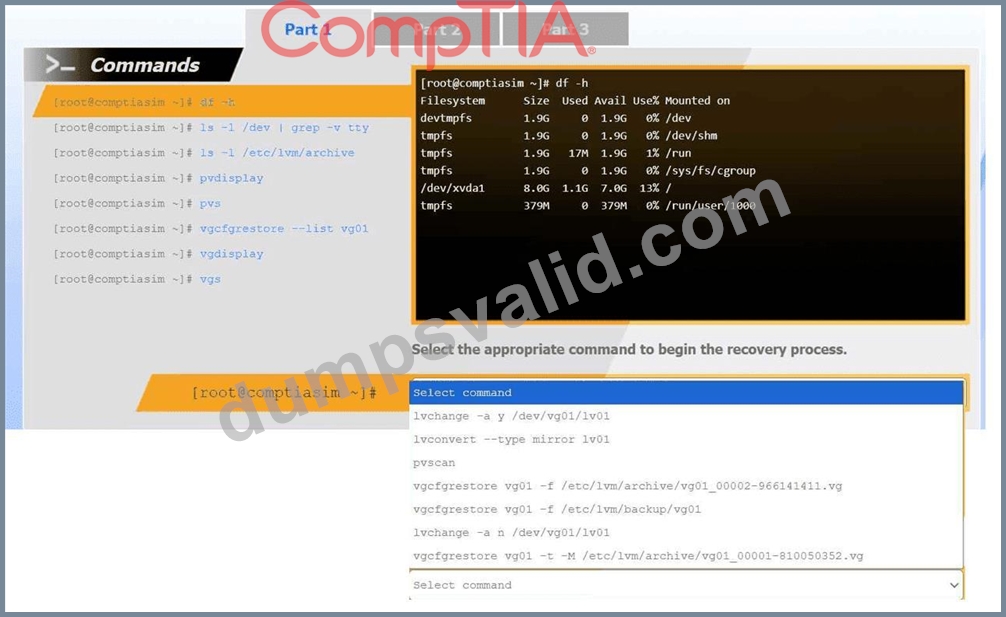
Answer:
Explanation: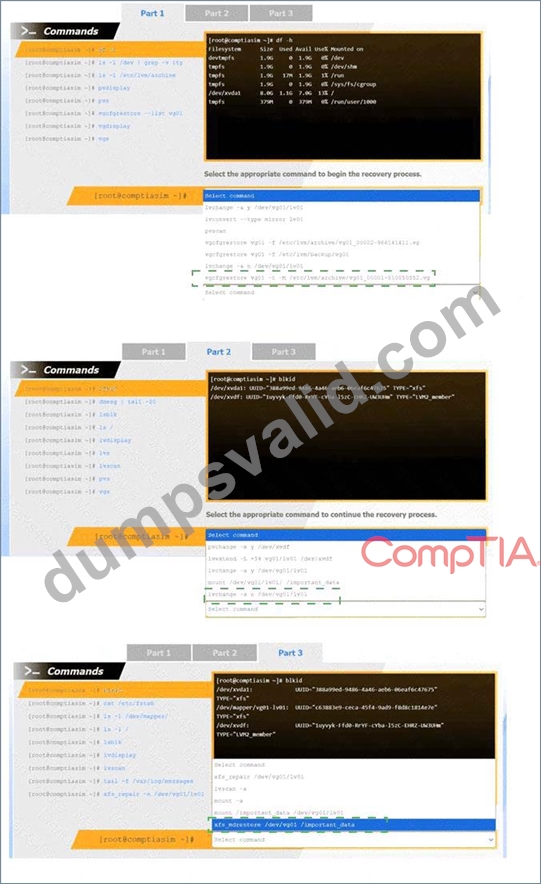
Explanation:
Part 1 - Begin the recovery process
vgcfgrestore vg01 -f /etc/lvm/archive/vg01_00001-810050352.vg
Part 2 - Continue the recovery process
lvchange -ay /dev/vg01/lv01
Part 3 - Complete recovery and access data
mount /dev/vg01/lv01 /important_data
This performance-based question tests LVM recovery, a critical System Management skill in CompTIA Linux+ V8. The scenario indicates that a logical volume was removed, but the underlying physical volume and volume group metadata still exist.
# Part 1: Restoring Volume Group Metadata
The first screenshot shows that:
Physical volumes (pvdisplay, pvs) still exist
The logical volume is missing
/etc/lvm/archive/ contains archived VG metadata
Linux automatically stores backups of LVM metadata in /etc/lvm/archive whenever changes are made. The correct first step is to restore the volume group metadata using:
vgcfgrestore vg01 -f /etc/lvm/archive/vg01_00001-810050352.vg
This restores the logical volume definitions but does not activate them yet.
This is the only correct starting point in Linux+ V8 recovery workflows.
# Part 2: Activating the Logical Volume
After metadata restoration:
The LV exists but is inactive
blkid shows the LV as TYPE= " LVM2_member "
The logical volume must be activated before it can be mounted:
lvchange -ay /dev/vg01/lv01
This makes the LV available under /dev/vg01/lv01.
Linux+ explicitly requires LV activation after recovery.
# Part 3: Accessing the Data
The final output shows:
The filesystem type is xfs
The logical volume is now visible
Since there is no indication of filesystem corruption, no repair is required.
The correct final step is to mount the filesystem:
mount /dev/vg01/lv01 /important_data
This restores full access to the underlying data.
NEW QUESTION # 110
An administrator receives a report that a user is unable to execute the runreports utility. The administrator logs in as the user, runs the following commands, and receives the following output:
$ runreports
runreports: command not found
$ ls -l /usr/local/bin
-rwxr-xr-x 1 root root 29 May 10 11:31 runreports
$ echo $PATH
/usr/sbin:/usr/bin:/sbin:/bin:/usr/games:/usr/local/games:/snap/bin
Which of the following best describes the issue and how to resolve it?
- A. The runreports utility does not have execute permissions. The administrator should add execute permissions.
- B. The user does not have the correct SELinux context. The administrator should modify the SELinux template.
- C. The runreports utility is not in the user ' s path. The administrator should modify the .bash_profile file.
- D. The runreports utility is a shell script but not owned by the user. The administrator should use chown.
Answer: C
Explanation:
In Linux, for a command to be executed by its name alone (without an absolute or relative path), the directory containing the executable must be listed in the user ' s PATH environment variable. According to the CompTIA Linux+ V8 objectives, troubleshooting " command not found " errors requires an investigation of the binary ' s location versus the current PATH configuration.
In this scenario, the utility runreports is located in /usr/local/bin. However, the output of echo $PATH reveals that /usr/local/bin is not present in the search directories. The current PATH includes /usr/sbin, /usr/bin, /sbin,
/bin, and others, but specifically excludes the location of the utility. Because the shell cannot find the file in any of its defined search paths, it returns " command not found. " To resolve this issue permanently for the user, the administrator should add /usr/local/bin to the user ' s PATH by modifying a shell initialization file, such as ~/.bash_profile or ~/.bashrc. Adding the line export PATH=$PATH:/usr/local/bin ensures the directory is included in future sessions.
The other options are incorrect based on the provided evidence. Option B is wrong because the ls -l output shows the file has r-x permissions for " others, " meaning the user can already execute it despite not being the owner. Option C is unlikely because SELinux typically results in " Permission Denied, " not " Command Not Found. " Option D is also incorrect as the ls -l output clearly shows the execute (x) bit is already set for all users (755).
Therefore, the missing PATH entry is the verified root cause.
NEW QUESTION # 111
User1 reports "access denied" errors while trying to execute app. Given the following outputs: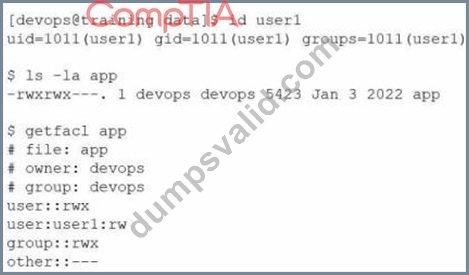
Which of the following options will remediate this issue?
- A. Moving app to a different folder
- B. Modifying the permissions for others to grant read, write, and execute
- C. Adding user1 to the wheel group
- D. Providing execute permissions to user1 in the ACL
Answer: D
Explanation:
According to the output of getfacl app, user1 has only "rw" (read and write) permissions, but lacks "x" (execute). Without execute permission, user1 cannot run the file. To allow user1 to execute app, you must update the ACL to add execute permission (e.g., setfacl -m u:user1:rwx app). Modifying "others" permissions (option B) is not secure or necessary, adding user1 to the wheel group (option C) is unrelated, and moving the file (option D) does not resolve permission issues.
Reference:
CompTIA Linux+ Study Guide: Exam XK0-006, Sybex, Chapter 7: "Securing Linux Systems", Section:
"Managing File and Directory Permissions and ACLs"
CompTIA Linux+ XK0-006 Objectives, Domain 3.0: Security
NEW QUESTION # 112
Which of the following passwords is the most complex?
- A. H3s@1dSh3t0|d
- B. H3sa1dt01d
- C. he$@ID$heTold
- D. HeSaidShetold
Answer: A
Explanation:
Password complexity is a fundamental concept within the Security domain of CompTIA Linux+ V8. Complex passwords significantly reduce the risk of successful brute-force, dictionary, and credential-stuffing attacks.
Linux+ emphasizes evaluating passwords based on length, character variety, unpredictability, and resistance to common word patterns.
Option C, H3s@1dSh3t0|d, is the most complex password among the choices. It demonstrates strong security characteristics by incorporating:
Uppercase letters (H, S)
Lowercase letters (s, d, t)
Numbers (3, 1, 0)
Multiple special characters (@, |)
A longer overall length compared to some other options
Additionally, option C uses character substitution (leet-style) in a way that breaks up recognizable words more effectively than the other choices. This significantly increases entropy and makes the password harder to guess using rule-based or hybrid cracking techniques.
Option A includes uppercase letters and numbers but lacks special characters and is relatively short. Option B includes special characters and mixed case, but it still closely resembles readable words, making it more susceptible to dictionary-based attacks. Option D uses only alphabetic characters and clear word patterns, making it the weakest choice.
Linux+ V8 documentation highlights that the strongest passwords combine length with diverse character classes and minimal predictability. Password C best meets all of these criteria and would score highest against common password-cracking strategies.
Therefore, the correct answer is C. H3s@1dSh3t0|d.
NEW QUESTION # 113
A Linux systems administrator makes updates to systemd-managed service configuration files. Which of the following commands should the administrator execute in order to implement the changes?
- A. systemctl restart
- B. systemctl daemon-reload
- C. systemctl enable
- D. systemctl start
Answer: B
Explanation:
In the systemd architecture, service configurations are stored in unit files (e.g., .service, .timer, .mount) located in directories like /etc/systemd/system/ or /usr/lib/systemd/system/. When an administrator modifies these files or creates new ones, the systemd manager does not automatically detect the changes. According to the CompTIA Linux+ V8 curriculum, the command systemctl daemon-reload is required to notify systemd that it needs to rescan the configuration directories and rebuild its internal dependency tree.
Without running daemon-reload, attempting to start or restart the service would result in systemd using the old, cached version of the unit file, or it might generate a warning stating that " the unit file on disk has changed. " This command is a safe operation that does not stop running services; it simply refreshes the manager ' s awareness of the current configuration.
The other options are insufficient for " implementing the changes " to the configuration files themselves.
systemctl enable (Option A) creates the links for starting the service at boot. systemctl start (Option B) attempts to launch the service. systemctl restart (Option C) stops and then starts a service, but if the unit file was changed and daemon-reload was not run, it may fail or use outdated settings.
Thus, systemctl daemon-reload is the essential first step after any modification to a systemd unit file.
NEW QUESTION # 114
......
DumpsValid is a website that not the same as other competitor, because it provide all candidates with valuable XK0-006 exam questions, aiming to help them who meet difficult in pass the XK0-006 exam. Not only does it not provide poor quality XK0-006 Exam Materials like some websites, it does not have the same high price as some websites. If you would like to try XK0-006 learning copyright from our website, it must be the most effective investment for your money.
XK0-006 Reliable Exam Price: https://www.dumpsvalid.com/XK0-006-still-valid-exam.html
- XK0-006 Latest Mock Exam ???? Dumps XK0-006 Discount ???? Latest XK0-006 Exam Preparation ???? Enter 「 www.testkingpass.com 」 and search for ➤ XK0-006 ⮘ to download for free ????Download XK0-006 Free Dumps
- 100% Pass CompTIA - XK0-006 - CompTIA Linux+ Certification Exam –The Best Books PDF ✉ Easily obtain 【 XK0-006 】 for free download through ✔ www.pdfvce.com ️✔️ ????XK0-006 Latest Mock Exam
- 100% Pass 2026 CompTIA Trustable Books XK0-006 PDF ???? Open ▷ www.dumpsmaterials.com ◁ and search for ✔ XK0-006 ️✔️ to download exam materials for free ????XK0-006 Certification Test Questions
- XK0-006 Latest Mock Exam ???? Latest XK0-006 Dumps Book ???? Download XK0-006 Free Dumps ???? Search for ⇛ XK0-006 ⇚ and download it for free immediately on ( www.pdfvce.com ) ????Certificate XK0-006 Exam
- XK0-006 Reliable Dump ???? Latest XK0-006 Test Pdf ???? Dumps XK0-006 Discount ???? Search on 《 www.pass4test.com 》 for [ XK0-006 ] to obtain exam materials for free download ????XK0-006 copyright
- CompTIA XK0-006 Practice Test - The Secret To Overcome Exam Anxiety ???? ( www.pdfvce.com ) is best website to obtain ✔ XK0-006 ️✔️ for free download ????Accurate XK0-006 Prep Material
- Test XK0-006 Cram Review ???? Test XK0-006 Cram Review ???? Prep XK0-006 Guide ???? Search for ▶ XK0-006 ◀ and obtain a free download on ▷ www.vce4dumps.com ◁ ????Download XK0-006 Free Dumps
- Pass XK0-006 Exam with Efficient Books XK0-006 PDF by Pdfvce ???? Download ⇛ XK0-006 ⇚ for free by simply entering ➡ www.pdfvce.com ️⬅️ website ????New XK0-006 Exam Prep
- CompTIA The Best Accurate Books XK0-006 PDF – Pass XK0-006 First Attempt ???? Open ➤ www.vce4dumps.com ⮘ enter 《 XK0-006 》 and obtain a free download ????XK0-006 Latest Mock Exam
- XK0-006 Certification Exam ???? Certificate XK0-006 Exam ⛲ Latest XK0-006 Dumps Book ???? 【 www.pdfvce.com 】 is best website to obtain ⇛ XK0-006 ⇚ for free download ????Test XK0-006 Cram Review
- Efficient CompTIA Books XK0-006 PDF and Newest XK0-006 Reliable Exam Price ???? Easily obtain free download of 《 XK0-006 》 by searching on ➤ www.vceengine.com ⮘ ????XK0-006 Reliable Dump
- worldlistpro.com, prestonoytl548029.blogpayz.com, bookmarkport.com, margiefsqc573563.gynoblog.com, lombok-directory.com, social-galaxy.com, orangebookmarks.com, robertncnt850774.wikikali.com, montykuhq625018.blogoxo.com, idarcjt568386.bloggerswise.com, Disposable vapes
BONUS!!! Download part of DumpsValid XK0-006 dumps for free: https://drive.google.com/open?id=1Z2xXbm1pbClSbbs-MrRTKDziC0bMqK21
Report this wiki page